Purpose Three: To Make Atonement for Iniquity Home


Daniel 9:24 KJV
Seventy weeks are determined upon thy people and upon thy holy city, to finish the transgression, and to make an end of sins, and to make reconciliation [atonement] for iniquity, and to bring in everlasting righteousness, and to seal up the vision and prophecy, and to anoint the most Holy.

Colossians 1:18-22 NKJV
18And He is the head of the body, the church, who is the beginning, the firstborn from the dead, that in all things He may have the preeminence. 19For it pleased the Father that in Him all the fullness should dwell, 20and by Him to reconcile all things to Himself, by Him, whether things on earth or things in heaven, having made peace through the blood of His cross. 21And you, who once were alienated and enemies in your mind by wicked works, yet now He has reconciled 22in the body of His flesh through death, to present you holy, and blameless, and above reproach in His sight.

"If a man is unsound on the blood, he is unsound in everything." - D.L. Moody (pg. 40)

"During this period of Seventy Weeks, God has provided a redemption through the death and resurrection of Christ. This, of course, is for Jew and Gentile alike." (Pg. 155 Daniel)
- J. Vernon McGee
"The third accomplishment of God's 70-week program is 'to make reconciliation for iniquity' or 'to atone for wickedness' (NIV). The verb in this sentence is kaphar, the Old Testament term used to denote the covering of sin by making a sacrifice. Hebrew scholar Keil says the form of the verb indicates that the word means 'to cover so thoroughly that the sin is obliterated.'" "Christians see this as having been fulfilled in the death of Jesus Christ, who according to the New Testament gave Himself to die on the cross as the perfect sacrifice." "the words 'to make reconciliation for iniquity' seem to denote something unique and special--an atonement that has been accomplished. - RBC Ministries (Page 10) (The Daniel Papers – RBC Ministries- Grand Rapids, MI)
The atonement has been accomplished in the past, reconciliation for iniquity is complete, which is clearly shown by Paul.
Colossians 1:18-22 NKJV
19For it pleased the Father that in Him [Jesus] all the fullness should dwell, 20and by Him to reconcile all things to Himself, by Him, whether things on earth or things in heaven, having made peace through the blood of His cross. 21And you, who once were alienated and enemies in your mind by wicked works, yet now He has reconciled 22in the body of His flesh through death, to present you holy, and blameless, and above reproach in His sight.

Due to our Iniquity (Wicked Works) we were all enemies of God. But Jesus reconciled us to God through the Blood and His death on the cross. Hebrews says that "once in the end of the world hath He [Christ] appeared to put away sin by the sacrifice of himself."
Micah 7:19 NKJV
He will turn again, he will have compassion upon us [Israel]; he will subdue our iniquities; and thou wilt cast all their sins into the depths of the sea.

Isaiah 53:5 says that Christ "was wounded for our [Israel's] transgressions, he was bruised for our [Israel's] iniquities". It follows that Isaiah was Jewish, and therefore the "our" refers to the people with whom he belongs, Israel. Therefore we can conclude, as McGee did, that Jesus made Atonement for Israel's sins at the cross, through His blood.
Hebrews 2:16-18 NIV
For surely it is not angels he helps, but Abraham's descendants. For this reason he had to be made like his brothers in every way, in order that he might become a merciful and faithful high priest in service to God, and that he might make atonement for the sins of the people [Israel]. Because he himself suffered when he was tempted, he is able to help those who are being tempted.

Romans 5:11 KJV
And not only so, but we also joy in God through our Lord Jesus Christ, by whom we have now received the atonement.
Recently I enjoyed reading a book by Dr. Oliver B. Greene on the "Atonement of Christ". There are few books written with atonement as the specific topic, and so I highly recommend the book. Here are several excerpts from the book.

"All major Bible doctrines proceed from or originate in His deity and His atonement." pg. 106 (Oliver B. Greene - The Atonement of Christ) "His atonement is finished (John 19:30); His priesthood is continuous." pg. 222 (Oliver B. Greene - The Atonement of Christ)

Jesus "met all the qualifications necessary to make an atonement for our sins." pg. 85 (Oliver B. Greene - The Atonement of Christ) And He "made atonement through His own shed blood!" pg. 82 (Oliver B. Greene - The Atonement of Christ) "Blood that was holy and undefiled, blood that made perfect atonement for sin." pg. 137 (Oliver B. Greene - The Atonement of Christ)

"He took the sinner's place; therefore He suffered all that sinners were supposed to suffer because of their sin. He made atonement, and in so doing it was a divine necessity that He suffer the penalty that sin brought upon man." pg. 100 (Oliver B. Greene - The Atonement of Christ)

"It is impossible to over-emphasize the importance of the atonement, because it is upon that divine truth that the entire structure of God's plan and program rests." "All Old Testament prophecy points to the atonement for fulfillment, and all ceremonial and religious rites typified the atonement made by the Lamb of God at Calvary." pg 3 Foreword (Oliver B. Greene - The Atonement of Christ)

"His soul must be made 'an offering for sin.' He must be 'cut off, but not for Himself,' that He might 'make reconciliation for iniquity and bring in everlasting righteousness.'" "The death of Jesus on the cross is the heart of Christianity, for without His death on Calvary the sacrifices and prophecies of the Old Testament Scripture would be void and empty, and the great facts recorded in the New Testament giving the fulfillment of these prophecies would mean nothing." pg. 79 (Oliver B. Greene - The Atonement of Christ)

It could be assumed that we have beat the point to death. Gap Theorists and all "Fundamental" Christians who take the bible literally believe that Jesus made atonement for sins at the cross, Right? Apparently, this is not the case. In fact, the reason I wrote this book was I found many who called themselves fundamentalists, did not believe that Atonement was completed at the cross.

Of all the books I read on Daniel, the most shocking was written by the "fundamental" dispensationalist Dr. Renald E. Showers. To prove the point that Atonement for Iniquity, spoken of in Daniel 9:24, was not yet fulfilled, he states, "Fruchtenbaum asserted that the fulfillment of Israel's seven holy seasons of Leviticus 23 takes place in the order in which those seasons occur. He pointed out that the Feast of Trumpets occurs before the Day of Atonement, Israel's day of affliction of soul and national atonement. He claimed that the Day of Atonement will 'be fulfilled by the seven years of Tribulation, during which Israel will suffer affliction leading to her national repentance and restoration." (Pg. 264-265 Marnatha)

Think of it, someone else's affliction other than Christ's fulfilling this purpose, "Atonement for Iniquity." Did I mention that Showers is not considered a radical liberalist, but instead a fundamentalist! I think all true fundamentalist would echo Greene's remark that "there is nothing man can do, live, or give to atone for sin because the sin-debt has been paid in full." pg. 65 (Oliver B. Greene - The Atonement of Christ) Spurgeon stated that "no man or woman born shall ever trust Christ in vain, or find the atonement insufficient for Him." (Pg. 92 - C.H. Spurgeon - Calvary's Cross)

Still though, the matter is not settled. About ninety percent of the dispensational books I read on Daniel held a view similar to that of McClain, who stated that "the phrase 'to make reconciliation for iniquity' does not here refer to the death of Christ, as some have assumed." (Pg. 66 McClain - Daniel) Instead, as Walvoord points out, "the actual application of it [the Atonement] is again associated with the second advent of Christ as far as Israel is concerned."

These dispensationalists missed what the purpose was, "to make Atonement for iniquity", not for "Israel to receive the atonement". As I showed previously, Atonement for Israel's iniquity was made at the cross. I received this atonement about thirty-five years ago. But that does not mean atonement for my sins was also made thirty-five years ago when I was saved. Rather, it was made at the cross. If asked when atonement was made for their sins, any fundamental preacher would surely state it was at the cross, not when they where saved! And if you are a fundamental Christian, I am quite sure you echo my sentiments that atonement was finished for everyone at the cross!

What's even more shocking is that after all the quotes I provided from Oliver B. Greene's book on "The Atonement of Christ," all of which stated atonement was finished at the cross; even Greene, in his book on Daniel agrees with the majority of dispensationalist that the atonement of the cross was "not in view here." Are we to believe that the bible teaches two separate atonements? If so where do we find this? Can someone's sins be atoned for through some other means other than the cross and by the blood of Christ?

Stating atonement for Israel took place at the cross creates a huge problem for the Gap Theory. Thus they have no choice but to defer this purpose as being fulfilled at Christ's second coming, thus doing violence to the gospel. To use Greene's own words, "the doctrine of atonement by the cross of the Lord Jesus Christ is divine truth, it is the very substance of the Gospel." pg. 125 (Oliver B. Greene - The Atonement of Christ)

We can see as a prime example with Greene that if a dispensationalist book is written with atonement as its sole topic, then atonement took place at the cross. However, in almost all cases, when a book is written in regards to this prophecy in Daniel, then atonement did not take place at the cross? If you are confused, believe me, I am too!

Here is the kicker of all flip flops. Even though in Greene's commentary on Daniel he states that atonement takes place at the second coming, in his book on atonement, he adds to this craziness, when he states that the prophecy of Daniel was fulfilled at the cross. "The prophecy of the seventy years was fulfilled in the Babylonian captivity; and this prophecy of the seventy weeks of years was just as certainly fulfilled in the appearance and crucifixion of the Lord Jesus Christ." pg. 69 (Oliver B. Greene - The Atonement of Christ) Are you confused yet?

The atonement is the most important bible doctrine, and one that God warns we should not manipulate as pointed out in Hebrews 10:29 (KJV) "Of how much sorer punishment, suppose ye, shall he be thought worthy, who hath trodden under foot the Son of God, and hath counted the blood of the covenant, wherewith he was sanctified, an unholy thing, and hath done despite unto the Spirit of grace?"

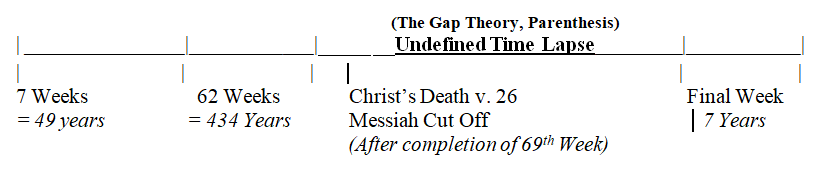
I stated earlier that atonement taking place at the cross creates a huge problem for the Gap theory. Let me now explain why. Below is a dispensational timeline that shall pinpoint this problem.

In order for the prophecy of Daniel 9:24-27 to be fulfilled, all six purposes determined in verse twenty four must be fulfilled in the determined amount of time; seventy weeks which equates to 490 years.

Very simply, to believe this dispensationalist timeline of events is to believe that "atonement for iniquity" was not fulfilled by Christ's death as it falls outside the 70 weeks. However, Isaiah 53:5 states Christ's death does fulfill this; "But He was wounded for our transgressions, He was bruised for our iniquities; The chastisement for our peace was upon Him, And by His stripes we are healed." Isaiah was speaking to National Israel when he wrote this. The obvious problem arises with this dispensational view because Christ's death occurs after the 7 weeks and 62 weeks have passed. This leaves only the final week for His death to take place in, in order to fulfill this purpose inside the 70 weeks determined in the prophecy. However, since dispensationalist put this final week in the future, in their theology, Christ's death did not bring this fulfillment. This would then raise the question, if this dispensational timeline is true, what future event ATONES FOR INIQUITY? Was it not Christ death? (cf. Isaiah 53:5)

Romans 10:12-13 KJV
12For there is no difference between the Jew and the Greek: for the same Lord over all is rich unto all that call upon him. 13For whosoever shall call upon the name of the Lord shall be saved.

It follows, that if you can say that Christ made atonement for you or any other Gentile, then He also made atonement for the Jew as well, as Paul explains in his letter to Romans.